
← All articles
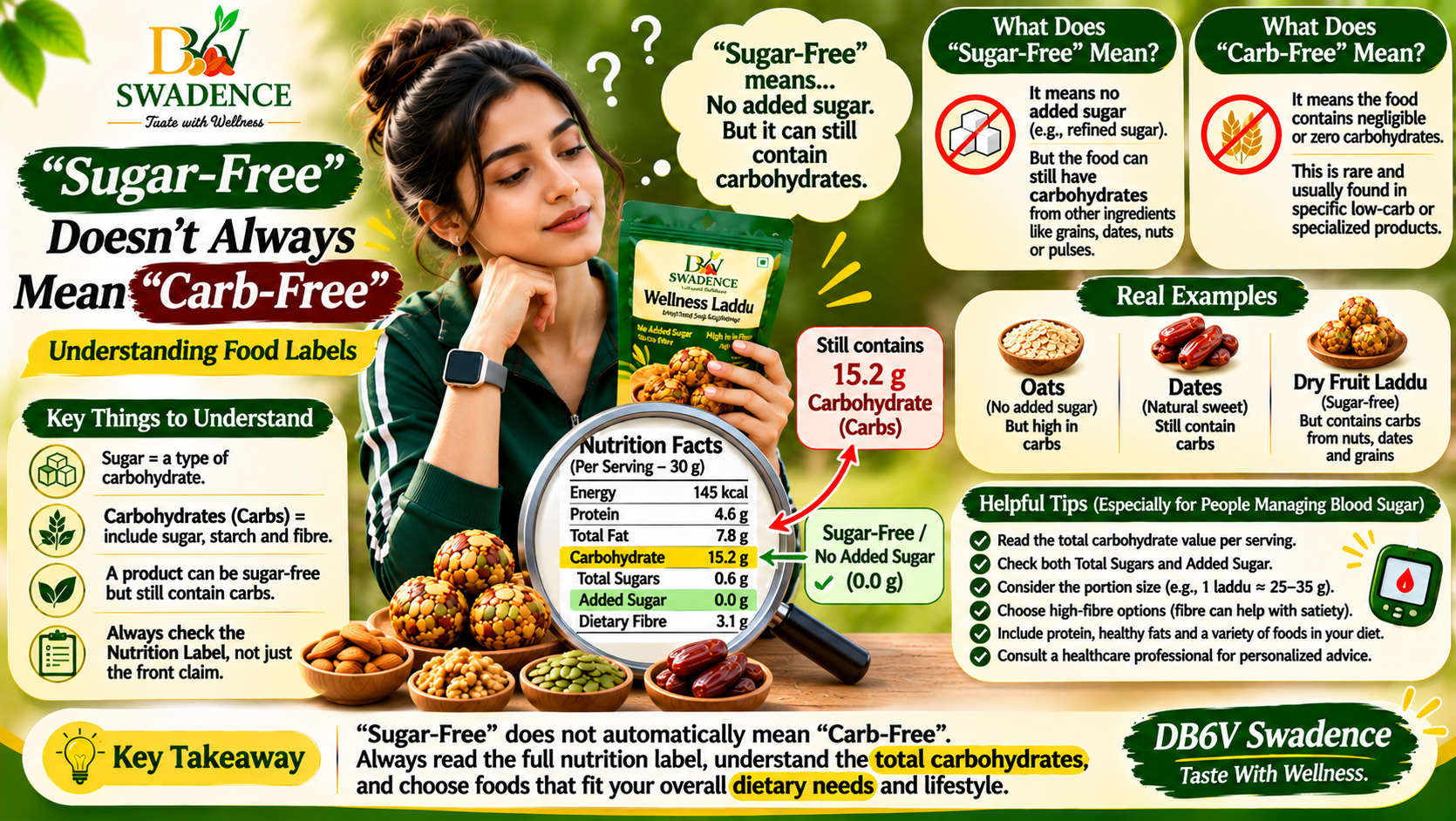
Sugar-Free Doesn't Always Mean Carb-Free: Understanding Food Labels and Nutrition
Sugar-Free Doesn't Always Mean Carb-Free: Understanding Food Labels and Nutrition
When shopping for packaged foods, one of the most attractive words consumers often notice is "Sugar-Free."
For people who want to reduce their sugar intake or become more conscious of their food choices, this label can seem like an easy way to identify a suitable product.
But there is something important that many consumers overlook:
Sugar-free does not necessarily mean carbohydrate-free.
A food product can contain no sugar or very little sugar while still providing carbohydrates from other ingredients.
For example, dates, grains, pulses, fruits and certain seeds can contribute carbohydrates to a recipe even when refined sugar is not added.
Understanding this difference is particularly important when choosing wellness foods, dry fruit snacks, protein bars, traditional laddus and other packaged products.
Let's understand how sugar and carbohydrates work, what food labels actually tell us and why reading nutritional information matters.
1. What Are Carbohydrates?
Carbohydrates are one of the three major macronutrients found in food, along with protein and fat.
They are an important source of energy for the human body.
Carbohydrates are present in many everyday foods, including:
- Rice and wheat.
- Oats and other grains.
- Fruits.
- Dates and raisins.
- Milk and dairy products.
- Pulses and legumes.
- Potatoes and other starchy vegetables.
- Certain nuts and seeds.
When we eat carbohydrates, the digestive system breaks down many of them into smaller sugars, which can enter the bloodstream.
Different carbohydrate-containing foods are digested and absorbed at different rates.
This is one reason the type, quantity and overall composition of food matter.
2. What Is the Difference Between Sugar and Carbohydrates?
Sugar is a type of carbohydrate.
However, not all carbohydrates are sugars.
Carbohydrates include different forms:
Simple Carbohydrates
These include sugars such as glucose, fructose and sucrose.
They are found naturally in foods such as fruits and milk, and may also be added to packaged products.
Complex Carbohydrates
These include starches and certain forms of dietary fibre.
They are found in foods such as whole grains, pulses and vegetables.
Dietary Fibre
Fibre is a type of carbohydrate that the human digestive system does not fully digest.
It contributes to digestive health and can influence how filling a meal feels.
Therefore, when a product contains no added refined sugar, it may still contain starch, fibre and naturally occurring sugars.
This is why checking total carbohydrates is important.
3. What Does Sugar-Free Actually Mean?
The term sugar-free is used to describe products that meet the applicable regulatory criteria for a sugar-free claim.
It does not automatically mean that the product contains zero carbohydrates.
For example, a specially formulated snack may use a non-sugar sweetener instead of refined sugar.
However, if the recipe also contains flour, grains or other carbohydrate-containing ingredients, the final product can still contain carbohydrates.
Consider these examples:
Sugar-Free Biscuit: May contain carbohydrates from flour and starch.
Sugar-Free Chocolate: May contain fat, protein and carbohydrates depending on its formulation.
Sugar-Free Snack Bar: May contain carbohydrates from grains, nuts or other ingredients.
Sugar-Free Dessert: May contain carbohydrates from milk or other recipe components.
The important lesson is to understand the complete nutritional composition rather than relying on one front-label claim.
4. Natural Sugar Is Still Sugar
Another common misunderstanding is that naturally occurring sugar does not count towards carbohydrate intake.
This is incorrect.
Some natural ingredients contain sugars that contribute to the total carbohydrate content of a food.
For example:
Dates
Dates contain naturally occurring glucose, fructose and other carbohydrates.
They also provide dietary fibre and certain minerals.
Raisins
Raisins contain concentrated natural sugars because they are dried grapes.
They also contribute small amounts of fibre and other nutrients.
Honey
Honey contains naturally occurring sugars, primarily glucose and fructose.
Although it is a natural product, it still contributes sugars and energy.
Jaggery
Jaggery is a traditional sweetener that primarily contains sugars.
It should not automatically be considered a sugar-free alternative.
Natural origin does not remove the need to consider quantity.
5. How Do Dates and Dry Fruits Affect Carbohydrate Intake?
Dates and dry fruits are frequently used in modern wellness-inspired recipes.
They can provide sweetness without relying entirely on refined sugar.
However, they still contribute carbohydrates.
For example, a dry fruit laddu may contain:
- Dates.
- Raisins.
- Almonds.
- Walnuts.
- Pumpkin seeds.
- Flax seeds.
- Other ingredients.
Each ingredient contributes differently to the nutritional profile.
Dates and raisins contribute natural sugars and carbohydrates.
Nuts and seeds contribute fats, protein, fibre and varying amounts of carbohydrates.
The final nutritional composition depends on the quantities used in the formulation.
Therefore, a dry fruit laddu should not automatically be described as sugar-free or low-carbohydrate simply because it does not contain refined sugar.
6. Why Total Carbohydrates Matter
When evaluating a packaged food, total carbohydrates provide more information than looking at sugar alone.
Consider a hypothetical nutritional label:
Nutritional Information| Per 100 g
Energy| 380 kcal
Total Carbohydrates| 55 g
Total Sugars| 8 g
Protein| 12 g
Total Fat| 14 g
Dietary Fibre| 7 g
This is only an illustrative example, not the nutritional profile of an actual Swadence product.
Notice that the product contains 55 grams of carbohydrates but only 8 grams of total sugars.
This demonstrates why sugar content and total carbohydrate content should not be treated as the same thing.
When evaluating a product, look at the complete nutrition panel.
7. Understanding Total Sugars and Added Sugars
Food labels may provide separate information about total sugars and added sugars.
Understanding the difference can help consumers make better decisions.
Total Sugars
This generally includes sugars naturally present in ingredients as well as sugars added during preparation.
For example, a product containing dates may have total sugars even when no refined sugar has been added.
Added Sugars
These are sugars added during food preparation or manufacturing.
Examples can include:
- Refined sugar.
- Certain sugar syrups.
- Added sweetening ingredients.
A product with no added sugar may still contain naturally occurring sugars.
This is particularly relevant when choosing products containing dates, raisins, fruits or dairy ingredients.
8. What Are Sugar Alcohols and Non-Sugar Sweeteners?
Some packaged foods use alternative sweetening ingredients instead of conventional sugar.
These include different types of non-sugar sweeteners and sugar alcohols.
Examples include:
Stevia: A sweetener derived from the leaves of the Stevia plant.
Monk Fruit Sweetener: A sweetener derived from monk fruit.
Erythritol: A sugar alcohol used in certain food formulations.
Xylitol: Another sugar alcohol used in some products.
These ingredients have different nutritional and digestive characteristics.
Some sugar alcohols may contribute carbohydrates or energy depending on the type and applicable labelling method.
Certain sugar alcohols can also cause digestive discomfort when consumed in larger amounts.
Therefore, consumers should check the complete ingredient list and nutrition information rather than assuming all alternative sweeteners work in the same way.
9. Why Food Labels Are Important for People Managing Diabetes
People living with diabetes often need to pay close attention to their carbohydrate intake.
This is because carbohydrate-containing foods can influence blood glucose levels.
However, different foods and formulations can affect individuals differently.
For someone managing diabetes, important information includes:
- Total carbohydrates per serving.
- Total sugars.
- Added sugars, where declared.
- Dietary fibre.
- Serving size.
- Number of servings consumed.
- Overall meal composition.
For example, a snack made with dates and nuts may not contain added refined sugar, but it can still contribute carbohydrates.
Similarly, a sugar-free packaged snack may contain starch or other carbohydrate sources.
Therefore, the words sugar-free or natural should never be used as the only basis for deciding whether a food is suitable for diabetes management.
Individual dietary advice from a qualified healthcare professional is important.
10. Why Portion Size Can Change Everything
Even when two products have similar nutritional values per 100 grams, their actual contribution to your diet depends on how much you consume.
Consider this hypothetical example:
A snack contains 40 grams of carbohydrates per 100 grams.
If one serving weighs 25 grams, the carbohydrate contribution from that serving is 10 grams.
If someone consumes 75 grams, the carbohydrate contribution becomes 30 grams.
This simple calculation demonstrates why serving size matters.
When reviewing a food label, always check whether the nutritional values are provided:
- Per 100 grams.
- Per serving.
- Per package.
Understanding these details can prevent common mistakes when estimating daily carbohydrate intake.
11. How to Read a Nutrition Label Correctly
A nutrition label contains several important details.
Here is a simple way to understand it.
Step 1: Check Serving Size
Find out how much food the nutritional information represents.
Step 2: Check Total Carbohydrates
This helps you understand the carbohydrate contribution.
Step 3: Review Total Sugars
Look at the amount of sugar present in the serving.
Step 4: Check Added Sugars
Understand whether additional sweetening ingredients have been used.
Step 5: Review Dietary Fibre
Fibre contributes to the nutritional profile and digestive health.
Step 6: Check Calories
Understand the energy provided by the serving.
Step 7: Read the Ingredient List
Identify the ingredients responsible for the product's nutritional composition.
Looking at all these details together gives a more complete picture than relying on one marketing claim.
12. Common Myths About Sugar-Free Foods
Let's clear up some common misunderstandings.
Myth 1: Sugar-Free Means Zero Carbohydrates.
Fact: A sugar-free product may still contain carbohydrates from grains, flour, starch or other ingredients.
Myth 2: Natural Sweeteners Do Not Affect Blood Sugar.
Fact: Natural sweeteners such as dates and honey contain sugars and can contribute to carbohydrate intake.
Myth 3: Jaggery Is Always Better Than Refined Sugar.
Fact: Jaggery primarily provides sugars and energy. Its nutritional contribution depends on the quantity consumed.
Myth 4: Dry Fruit Laddus Are Always Low in Sugar.
Fact: Their sugar and carbohydrate content depends on the quantity of dates, raisins and other ingredients used.
Myth 5: Sugar-Free Foods Can Be Eaten Without Limits.
Fact: Portion size, calories, carbohydrates and the complete nutritional composition still matter.
Myth 6: Every Sugar-Free Product Is Suitable for Diabetes.
Fact: Suitability depends on the formulation, serving size and individual dietary requirements.
13. How to Make More Informed Food Choices
Understanding nutrition labels does not need to be complicated.
A few simple habits can make everyday food decisions easier.
1. Read the complete ingredient list.
2. Compare total carbohydrates rather than checking sugar alone.
3. Understand the difference between added and naturally occurring sugars.
4. Check the nutritional information per serving.
5. Pay attention to portion size.
6. Do not assume natural sweeteners are carbohydrate-free.
7. Include fibre-rich foods in your overall diet.
8. Avoid relying entirely on front-label marketing claims.
9. Consider your individual dietary requirements.
10. Seek professional advice when managing a medical condition.
The objective is not to eliminate every carbohydrate-containing food.
It is to understand what you eat and how different foods fit into your overall dietary pattern.
14. How DB6V Swadence Approaches Ingredient Transparency
At DB6V Swadence, we believe consumers should understand the ingredients used in their everyday food.
Traditional Indian recipes often combine nuts, seeds, grains, pulses, ghee and naturally sweet ingredients.
Each ingredient contributes differently to the final product.
Our philosophy focuses on:
Thoughtful Ingredients: Understanding the role of different ingredients in a formulation.
Traditional Inspiration: Taking inspiration from familiar Indian food preparations.
Portion Awareness: Our 30-sachet concept is designed to provide convenient individual servings.
Transparency: Helping customers understand ingredients and nutritional information.
Responsible Communication: Avoiding exaggerated health claims and encouraging informed food choices.
We believe that a wellness-inspired food should be understood through its complete formulation rather than a single label or marketing phrase.
The nutritional characteristics of a Swadence product depend on its actual ingredients, formulation and serving size.
15. The Bigger Picture: Understanding Food Instead of Following Labels
Food labels are useful tools, but they should never replace an understanding of nutrition.
A product labelled natural may still contain significant carbohydrates.
A sugar-free product may still provide calories.
A dry fruit snack may contain beneficial nutrients while also being energy-dense.
The goal is to understand these differences instead of judging food through a single word on its packaging.
Once you become comfortable reading nutrition labels, you can make more informed decisions about everyday snacks, traditional foods and packaged wellness products.
Frequently Asked Questions
Q1. Does sugar-free mean carbohydrate-free?
No. A sugar-free food can still contain carbohydrates from ingredients such as grains, flour, starch, pulses and fruits.
Q2. Are dates sugar-free?
No. Dates contain naturally occurring sugars and carbohydrates, although they also provide fibre and certain micronutrients.
Q3. Is jaggery better than refined sugar for people with diabetes?
Jaggery still contains sugars and can affect blood glucose levels. It should not be considered a diabetes-safe alternative to refined sugar.
Q4. Can dry fruit laddus contain carbohydrates?
Yes. Ingredients such as dates and raisins contribute carbohydrates. Nuts and seeds also contribute varying amounts of carbohydrates, fats, protein and fibre.
Q5. What is the difference between total sugars and added sugars?
Total sugars include naturally occurring and added sugars, while added sugars refer to sugars introduced during preparation or manufacturing.
Q6. Why should people with diabetes check total carbohydrates?
Because carbohydrate-containing foods can influence blood glucose levels. Total carbohydrate information provides a broader understanding than sugar content alone.
Q7. Are natural sweeteners healthier than refined sugar?
Their nutritional characteristics differ, but natural sweeteners are not automatically calorie-free or suitable for unlimited consumption.
Q8. Can a sugar-free snack still contain calories?
Yes. Calories can come from fats, proteins and carbohydrates even when a product contains very little sugar.
Q9. What should I check before buying a sugar-free product?
Review the ingredient list, total carbohydrates, total sugars, serving size, nutritional information and any applicable sweetener declarations.
Q10. Are all sugar-free foods suitable for everyday consumption?
Not necessarily. Suitability depends on the complete nutritional composition, serving size and individual dietary needs.
Final Thoughts
Understanding the difference between sugar and carbohydrates is an important part of making informed food choices.
A sugar-free label may sound attractive, but it does not tell the complete story of a product.
Always look beyond the front of the package.
Read the ingredient list, check total carbohydrates, understand serving sizes and pay attention to the complete nutritional information.
At DB6V Swadence, we believe that better food awareness begins with understanding ingredients and making conscious everyday choices.
Because knowing what goes into your food is just as important as enjoying its taste.
DB6V Swadence – Taste With Wellness.