← सभी लेख
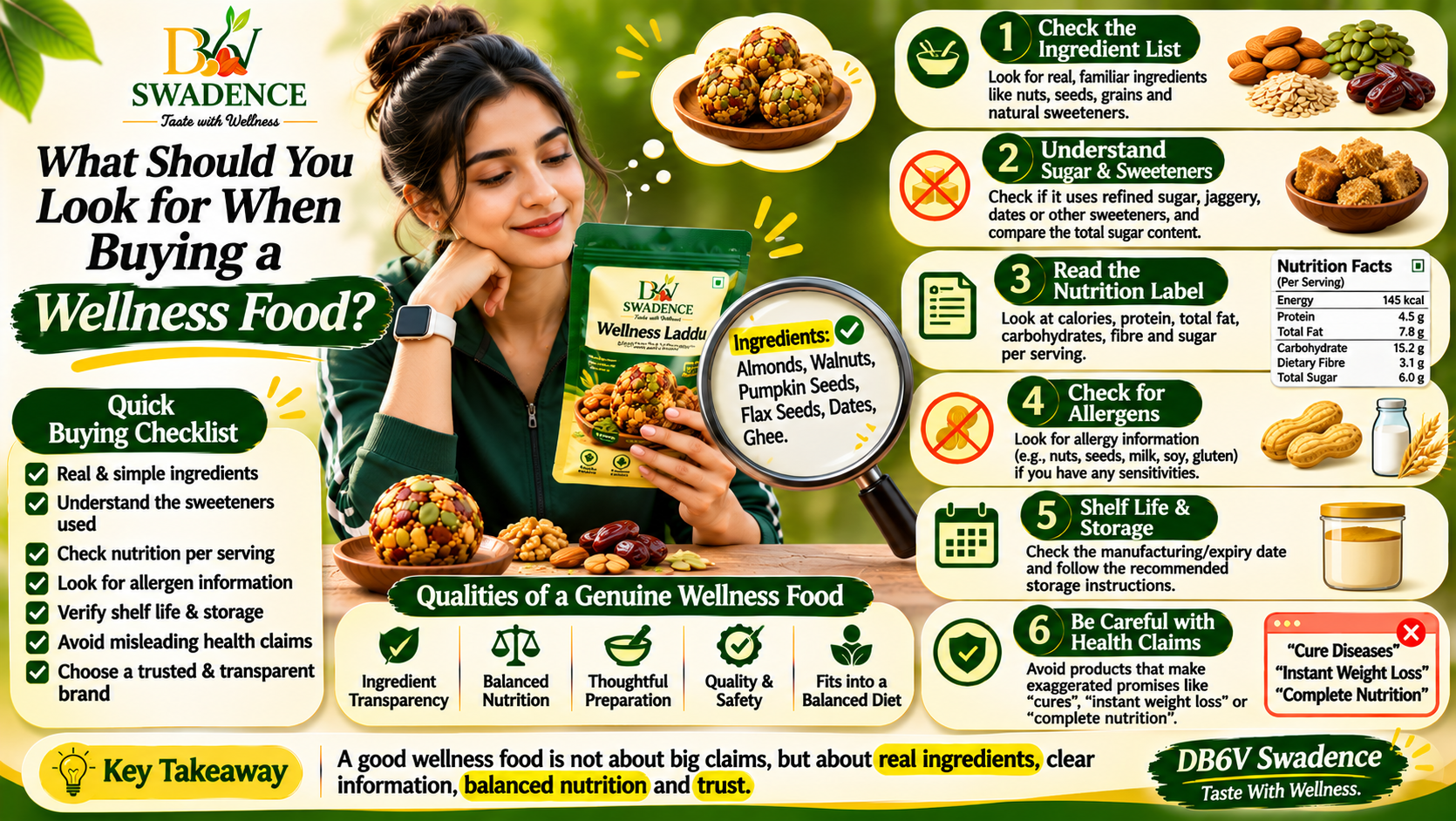
What Should You Look for When Buying a Wellness Food? A Complete Buying Guide
What Should You Look for When Buying a Wellness Food? A Complete Buying Guide
The wellness food market has grown significantly as more people become conscious of what they eat.
From dry fruit laddus and protein snacks to seed mixes, herbal preparations and nutritious food combinations, consumers today have more choices than ever before.
But with so many products available, choosing the right one can become confusing.
Beautiful packaging, attractive advertisements and words such as natural, sugar-free, superfood and immunity-boosting can influence purchasing decisions.
However, a good wellness food should offer more than attractive marketing.
Its ingredients, nutritional composition, serving size, preparation, safety and transparency deserve equal attention.
Whether you are purchasing a traditional dry fruit laddu or a modern wellness snack, understanding the product before buying can help you make more informed food choices.
Here are 12 important things to check when choosing a wellness food.
1. Always Read the Complete Ingredient List
The ingredient list is one of the most important parts of a packaged food label.
It tells you what has actually been used to prepare the product.
Before purchasing a wellness food, check:
- Which ingredients are included?
- Are nuts and seeds clearly mentioned?
- What type of grains or flour is used?
- Which sweetening ingredients are present?
- Are there any additives or preservatives?
- Does the ingredient list match the product description?
For example, a dry fruit laddu may contain almonds, walnuts, dates, seeds, ghee and other ingredients.
But the quantity of each ingredient can vary significantly between products.
An attractive product name does not automatically indicate a particular nutritional composition.
Reading the complete ingredient list gives you a better understanding of what you are purchasing.
2. Understand the Type of Sweetener Used
Sweetness is an important consideration when purchasing wellness foods.
Different products use different sweetening ingredients, including:
Refined Sugar: Commonly used in traditional sweets and packaged snacks.
Dates: Provide natural sweetness along with carbohydrates, fibre and some micronutrients.
Raisins: Contain naturally occurring sugars and small amounts of fibre and minerals.
Jaggery: A traditional sweetener that primarily contributes sugars and energy.
Monk Fruit Sweetener: Used in some formulations as a non-sugar sweetening option.
However, natural sweeteners are not automatically calorie-free or suitable for unlimited consumption.
Dates, raisins and jaggery still contribute carbohydrates.
If you are monitoring your sugar or carbohydrate intake, understanding the actual sweetening ingredients is important.
Do not rely only on front-label descriptions such as natural sweetness or no refined sugar.
3. Check the Nutritional Information
A product's nutritional information helps you understand what you are consuming.
Look for the nutrition panel and review the values per serving.
Important nutritional details include:
Energy: Indicates the calories provided by a serving.
Protein: Helps you understand the protein contribution.
Total Fat: Shows the amount of fat present.
Saturated Fat: Helps you understand the saturated fat content.
Carbohydrates: Indicates the total carbohydrate contribution.
Dietary Fibre: Shows the fibre content.
Total Sugars: Helps you understand the total sugar content.
Sodium: Indicates the sodium contribution.
Compare products using the same serving size whenever possible.
For example, comparing nutrition per 100 grams can be useful when two products have different serving sizes.
A product containing nutritious ingredients may still be relatively high in calories, fats or carbohydrates.
The complete nutritional profile matters more than a single attractive number.
4. Pay Attention to Serving Size
One of the most overlooked details on packaged food labels is serving size.
A nutritional panel may display values for a small serving rather than the entire package.
For example, if a package contains 300 grams and the nutritional information is provided per 30 grams, consuming the entire package means consuming ten servings.
This can significantly change your understanding of the nutritional information.
Always check:
- How much does one serving weigh?
- How many servings are in the package?
- Is the serving size realistic for your eating habits?
- How many calories does the complete package contain?
Understanding serving size helps you make better comparisons and manage your daily food intake.
5. Check Allergen Information Carefully
Food allergies are an important safety consideration.
Wellness foods frequently contain ingredients such as almonds, walnuts, peanuts, sesame seeds, milk products and other potential allergens.
If you have a known food allergy, carefully review the allergen declaration before purchasing.
Pay attention to:
Nuts: Almonds, walnuts, cashews and peanuts.
Seeds: Sesame and other seeds that may cause allergic reactions.
Dairy: Milk, ghee and milk-derived ingredients.
Gluten: Wheat and other gluten-containing grains.
Soy: Used in some packaged food formulations.
Also check cross-contamination warnings, such as whether the product is manufactured in a facility that handles other allergens.
Never assume a product is allergy-safe simply because its main ingredients appear suitable.
6. Verify Manufacturing Date and Shelf Life
Freshness and storage are important for maintaining food quality.
Products containing nuts, seeds and natural fats require appropriate storage because fats can develop unpleasant flavours when they become oxidized.
Before purchasing, check:
- Manufacturing date.
- Expiry date or best-before date.
- Batch or lot number.
- Packaging condition.
- Storage instructions.
- Manufacturer details.
Avoid purchasing products with damaged, leaking or improperly sealed packaging.
After opening a product, follow the manufacturer's storage recommendations.
Proper storage helps maintain the product's expected quality and freshness.
7. Understand Natural, Sugar-Free and No Added Sugar Claims
Food packaging often uses attractive words to communicate product benefits.
However, different claims have different meanings.
Natural
The word natural does not automatically mean that a product is nutritionally superior or suitable for everyone.
Always examine the ingredients and nutritional information.
Sugar-Free
Sugar-free does not necessarily mean carbohydrate-free.
A product may contain carbohydrates from dates, grains, pulses or other ingredients.
No Added Sugar
This generally indicates that sugars have not been added as ingredients, but the product may still contain naturally occurring sugars.
Organic
Organic claims should be supported by appropriate certification or other applicable regulatory requirements.
Gluten-Free
People who need to avoid gluten should check the relevant label declarations and applicable certification requirements.
The important lesson is simple: understand the actual claim instead of relying only on attractive words.
8. Be Careful With Exaggerated Health Claims
Some wellness products use marketing language that promises more than food can realistically deliver.
Be cautious when a product claims:
- Guaranteed weight loss.
- Instant immunity improvement.
- Complete detoxification.
- Guaranteed blood sugar control.
- Disease treatment or prevention.
- Immediate results without lifestyle changes.
Food products should not be presented as replacements for prescribed medical treatment.
For example, a snack containing almonds and seeds may provide useful nutrients, but that does not make it a treatment for a medical condition.
Responsible food brands should communicate nutritional information without making exaggerated promises.
9. Look for Manufacturer and Brand Transparency
Trust is an important part of purchasing packaged food.
A reliable food brand should provide clear information about the company responsible for manufacturing or marketing the product.
Look for:
- Brand and manufacturer name.
- Complete business address.
- FSSAI licence or registration details, as applicable.
- Customer care information.
- Batch identification.
- Manufacturing and expiry information.
- Relevant food safety declarations.
In India, packaged food businesses must follow applicable food safety and labelling requirements.
Checking these details can help consumers make more informed purchasing decisions.
10. Understand Packaging and Storage Requirements
Packaging does more than make a product look attractive.
It also helps protect food from environmental factors such as moisture, air and contamination.
For products containing nuts and seeds, suitable packaging is particularly important because their natural fats can be affected by oxidation.
Look for:
Proper Sealing: The package should be securely sealed.
Food-Grade Packaging: Packaging should be suitable for its intended food use.
Storage Instructions: Follow the manufacturer's recommendations.
Packaging Condition: Avoid damaged or tampered packaging.
Individual Portions: Separate sachets can offer convenience and make serving quantities easier to manage.
Packaging quality and appropriate storage both contribute to maintaining expected product quality.
11. Consider Convenience Without Ignoring Nutrition
Modern lifestyles often involve busy schedules.
Many consumers prefer snacks that are easy to carry, store and consume.
This is where individually portioned wellness foods can be useful.
For example, a 30-day sachet system can provide:
- Convenient daily servings.
- Easier portion awareness.
- Simple storage and carrying.
- Less need for daily measuring.
- A more organized snack routine.
However, convenience alone does not determine nutritional quality.
A convenient product should still have a transparent ingredient list, understandable nutritional information and appropriate serving sizes.
12. Compare Products Before Making a Purchase
Do not select a wellness food simply because it is more expensive or has premium packaging.
A better approach is to compare products based on meaningful information.
Consider these factors:
What to Compare| What to Check
Ingredients| Complete ingredient list
Sweeteners| Type and quantity
Nutrition| Calories, protein, fats and carbohydrates
Fibre| Dietary fibre per serving
Serving Size| Actual quantity per serving
Allergens| Nut, seed, dairy and other warnings
Shelf Life| Manufacturing and expiry dates
Safety| Manufacturer and FSSAI details
Claims| Whether marketing claims are supported
Value| Price compared with quantity and formulation
Comparing products helps you understand what you are paying for.
The objective should be to choose a product that suits your dietary needs, preferences and budget.
13. Questions to Ask Before Buying a Wellness Food
Before purchasing any packaged wellness snack, ask yourself a few simple questions:
1. Do I understand all the ingredients?
2. What sweeteners have been used?
3. Have I checked the nutrition panel?
4. Do I know the serving size?
5. Are there any ingredients I need to avoid?
6. Is the packaging properly sealed?
7. Have I checked the manufacturing and expiry dates?
8. Are the health claims realistic?
9. Is the manufacturer clearly identified?
10. Does the product fit into my overall eating routine?
These questions can make everyday food shopping more informed and practical.
14. How DB6V Swadence Approaches Wellness Food
At DB6V Swadence, we believe that customers should understand the food they choose.
Our philosophy is inspired by traditional Indian food preparations and the idea of combining familiar ingredients in a thoughtful way.
We focus on five important principles.
Ingredient Awareness
Understanding the role of ingredients such as almonds, walnuts, seeds, grains and other components used in our formulations.
Thoughtful Preparation
Giving attention to ingredient handling, preparation methods, flavour and texture.
Portion Convenience
Our 30-sachet concept is designed around convenient individual portions, making daily serving routines easier to follow.
Transparency
Helping customers understand product ingredients and nutritional information.
Traditional Inspiration
Bringing familiar Indian food ideas into convenient formats suited to modern routines.
We believe wellness food should be about informed choices rather than unrealistic promises.
The nutritional characteristics of any Swadence product depend on its actual formulation and declared serving size.
15. Why Informed Food Choices Matter
Choosing a wellness food should not be a complicated process.
Once you understand how to read food labels, compare ingredients and evaluate marketing claims, purchasing decisions become easier.
You do not need to follow every new food trend or purchase products simply because they are labelled as superfoods.
Instead, focus on:
- Ingredient quality.
- Nutritional composition.
- Appropriate portions.
- Food safety.
- Transparent labelling.
- Personal dietary requirements.
These principles can help you make more conscious choices over time.
Frequently Asked Questions
Q1. What should I check first when buying a wellness food?
Start with the complete ingredient list, nutritional information, serving size and allergen declaration.
Q2. Is expensive wellness food always better?
No. Price and packaging do not automatically indicate nutritional quality. Compare ingredients, nutritional information and product transparency.
Q3. Does natural mean healthy?
Not necessarily. Natural ingredients can still contain significant amounts of sugar, fat or calories. The complete nutritional composition matters.
Q4. What is the difference between sugar-free and no added sugar?
Sugar-free refers to a specific regulated nutritional claim, while no added sugar indicates that sugars have not been added as ingredients. Neither automatically means carbohydrate-free.
Q5. Why is serving size important?
Serving size helps you understand how much energy, sugar, fat, protein and other nutrients you consume.
Q6. Why should I check allergen information?
It helps identify ingredients that may cause allergic reactions and provides information about possible cross-contact.
Q7. How do I check whether a packaged food is fresh?
Review the manufacturing date, expiry or best-before date, batch information, packaging condition and storage instructions.
Q8. Are wellness foods suitable for people with diabetes?
Not automatically. They should review total carbohydrates, sugars, serving size and individual dietary requirements with appropriate professional guidance.
Q9. What does FSSAI mean on food packaging?
FSSAI refers to the Food Safety and Standards Authority of India, the regulatory authority responsible for food safety and standards in India.
Q10. Are individually packed wellness snacks useful?
They can make storage, carrying and portion management more convenient. Their nutritional suitability still depends on the ingredients and serving size.
Final Thoughts
A good wellness food is not defined by attractive packaging, expensive ingredients or impressive marketing claims.
It is defined by what goes into the product, how it is prepared, its nutritional composition and how transparently that information is communicated.
Before purchasing your next wellness snack, take a moment to read the label, understand the ingredients and check the serving size.
Small steps towards informed food choices can make a meaningful difference in everyday eating habits.
At DB6V Swadence, we believe traditional food inspiration, thoughtful ingredients and transparency belong together.
Because choosing better food begins with understanding what you eat.
DB6V Swadence – Taste With Wellness.